Compare a can of potato crisps today with the same product you bought a year ago. It may look almost identical on the supermarket shelf, but pick it up and it might feel lighter.
The familiar price may still be RM5.90 or RM6.90, but the net weight printed near the bottom of the packaging has changed.
At a restaurant, it may appear as fewer pieces of chicken, a smaller drink or less protein in a rice set.
This is what we call shrinkflation: the amount of product decreases while the selling price stays the same, or does not fall enough to reflect the smaller quantity.
For consumers, the result is simple: the price on the shelf may look unchanged, but the cost per gram, millilitre or serving has increased, making it more expensive per serving.
For companies, shrinkflation is a little more complicated.
Why are Malaysians noticing shrinkflation now?
Malaysia’s Food and Beverages inflation rate was 1.4% year on year in June 2026. Food prices increased for 169 of the 247 food items tracked by the Department of Statistics Malaysia, or DOSM.
That sounds moderate, especially compared with the sharper food inflation experienced several years ago. In June 2025, Food and Beverages inflation had been 2.1%.
But headline inflation does not always match what a shopper feels while filling a trolley.
A household may see a familiar Julie biscuit packet at the same price and assume nothing has changed. The difference becomes obvious only after comparing the old and new net weights, if they decide to make a social media post comparing the two, then you have a new problem.
That said, a move from RM6 to RM6.50 is visible immediately while a move from 200g to 180g may be hidden in small print or if the customer is eagle-eyed.
That feeling that food became noticeably more expensive after Covid-19 is supported by the data. Malaysia’s Food and Beverages inflation accelerated to 5.7% in 2022, before easing to 3.6% in 2023 and 1.7% in 2024.
“Compounded together, those three years alone lifted average food prices by roughly 11.5%, and that came on top of the increases recorded during 2020 and 2021.”
How much more are shoppers actually paying?
For shoppers, the number on the store shelf doesn’t really tell you the full story. It’s the unit price that matters.
Suppose a can of potato crisps sells for RM6.
Pack size | Shelf price | Price per 100g |
Previous pack: 200g | RM6.00 | RM3.00 |
New pack: 180g | RM6.00 | RM3.33 |
The can still costs RM6, but the price per 100g has risen by about 11%.
Now consider a packet of biscuits reduced from 300g to 270g while remaining at RM4.50. That is also an 11% increase in the effective price per gram.
The formula is straightforward:
Unit price = Selling price ÷ Product quantity
For easier comparison, shoppers and retailers can convert the result into a price per 100g, per litre or per piece.
This calculation matters because Malaysian consumers often shop around familiar price points. A brand may work hard to keep a product below RM5, RM10 or RM20 because crossing that threshold could reduce sales.
A manufacturer may therefore decide that keeping the RM5.90 price is safer than raising it to RM6.00 but reducing its grammage.
What other forms can shrinkflation take?
Shrinkflation is not limited to reducing the weight printed on a packet.
It can appear as:
- Fewer biscuits in a tray
- Fewer sachets in a multipack
- Smaller beverage bottles
- Less powder in a refill pack
- Fewer tea bags in a box
- Smaller restaurant portions
- Fewer toppings or side dishes
- More empty space inside the packaging
There are also related practices that businesses should distinguish from shrinkflation.
Skimpflation
Occurs when the quantity remains similar but the product quality falls. A company might use less of an expensive ingredient, change the recipe or replace a premium input with a cheaper alternative.
Service shrinkflation
When a customer pays the same but receives less service. That might mean shorter service hours, fewer customer-service staff or previously free extras becoming chargeable.
Portion downsizing
Mainly used in F&B. A plate of nasi campur may contain a smaller piece of fish. A café drink may come in a smaller cup or a rice set may have less meat while retaining the same menu price.
Why do manufacturers shrink products instead of raising prices?
Usually, the company is trying to protect a target price point and Malaysians are quite sensitive to it.
Manufacturers may be facing higher costs for ingredients, packaging, electricity, wages, transport, warehousing and retailer promotions. Imported inputs also expose the business to exchange-rate movements or conflicts that hinder supply chains like the West Asia conflict.
Business then has several choices:
- Raise the retail price.
- Absorb the additional cost.
- Reduce promotional discounts.
- Reformulate the product.
- Reduce the pack size.
- Introduce a different pack format.
A direct price increase is transparent but risky. Price-sensitive shoppers may switch to a cheaper competitor, wait for a promotion or move to a supermarket’s private-label alternative.
Reducing the pack size can preserve the brand’s visible price point and its place within a shopper’s immediate budget.
This is part of what the industry calls price-pack architecture: Designing a range of pack sizes and prices for different consumers, channels and consumption occasions.
For example, a brand may offer a RM2 single-serving pack at a convenience store, a RM6 standard pack at a supermarket and a larger family pack for shoppers seeking better unit value.
What are the risks of Shrinkflation for Businesses?
1) Loss of Trust
Consumers will understand that cocoa, coffee, dairy, flour or packaging costs have increased due to explainable factors.
But what frustrates them is discovering that a product became smaller without an obvious explanation.
2) Weaker value perception.
A national brand may retain its RM7 shelf price, but after downsizing it could cost considerably more per 100g than a local competitor or private-label product.
3) Brand switching
Once shoppers start checking net weight, they may also compare ingredients, promotions and competing products.
Shrinkflation can unintentionally encourage consumers to reconsider a purchase they previously made out of habit or loyalty,
4) SKU complexity.
A little more obscure but equally as important! Adding several pack sizes means more packaging materials, inventory records and demand forecasts.
Retailers also have limited shelf space. They may not welcome six slightly different pack sizes from the same brand, especially when some sell slowly.
5) Higher packaging cost
A smaller packet may protect gross margin per unit, but the company may use more plastic, cardboard, labels and handling effort for the same total volume sold.
What should Business do before shrinking a pack?
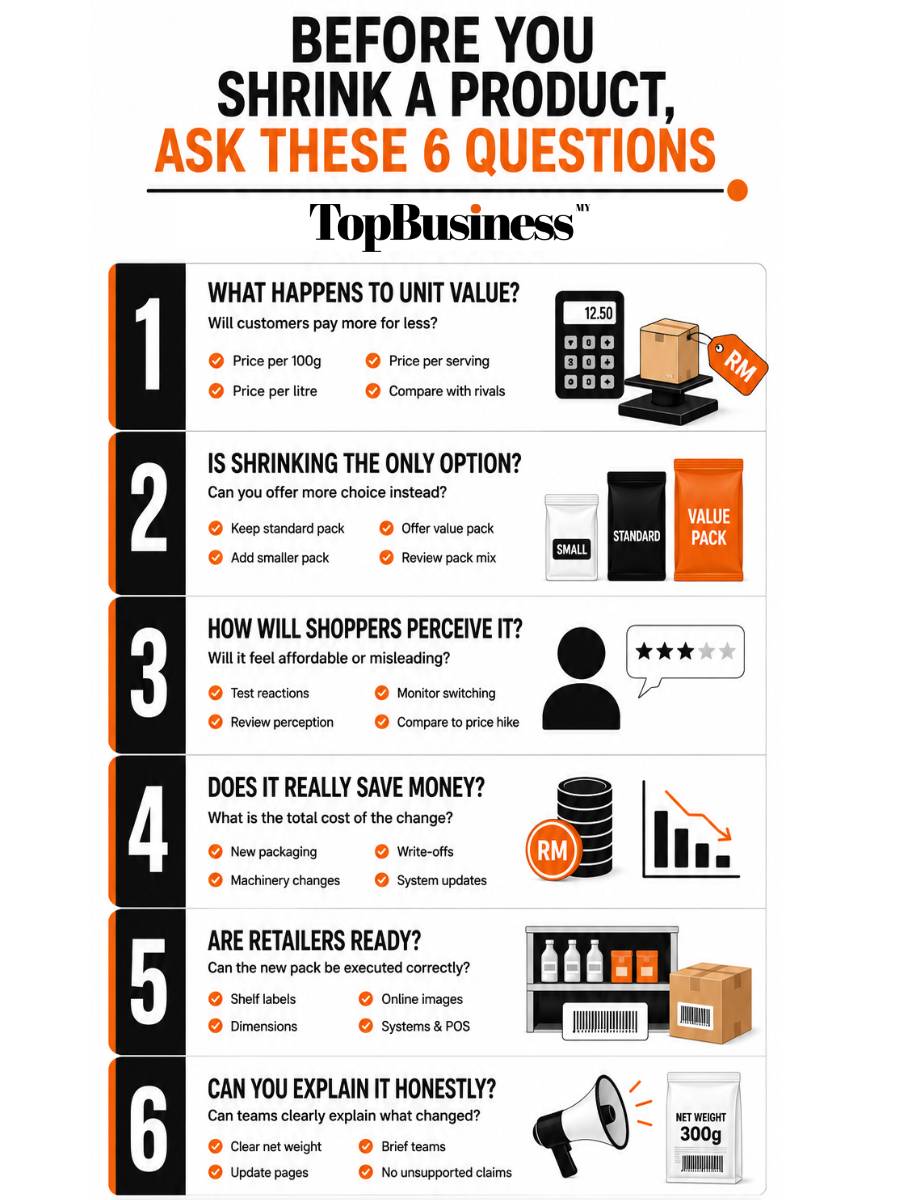
A familiar-looking pack with an unfamiliar quantity may protect revenue for a quarter, but it can also create a much longer problem if loyal customers feel misled, and loyalty is your greatest asset.
Smaller packs are not the problem? Value proposition is
Shoppers already understand that business costs change. They see it in supermarket bills, restaurant menus and delivery charges.
But at the end of the day, they just want to know “is it still worth buying”.
- For consumers, they can compare to other brands and pick alternatives.
- For companies, they need to think about customer trust and loyalty.
Our opinion is this, companies that handle it best will give customers clear choices: an affordable small pack, a standard pack and a larger value option.
The shelf price may attract the first purchase but transparent value is what protects the next one.
At TopBusiness, we cover businesses and economy news that affect the daily lives of our fellow Malaysians. Our business news site covers consumer demand and the ongoing economy news that you deserve to know.